DvalinCode: a coding agent you can actually let into a regulated codebase
Most coding agents assume trust: give them a shell, a model key, and your repo, and let them go. That assumption is fine on a hobby project and a non-starter in a bank. DvalinCode is my answer to a narrower question — what does a coding agent look like if it has to satisfy an auditor?
It’s an AI coding agent in TypeScript, MIT-licensed, with 183 passing tests, that runs as terminal, web, and desktop from a single binary. The interesting parts aren’t the frontends, though — they’re the constraints.
The shape of it
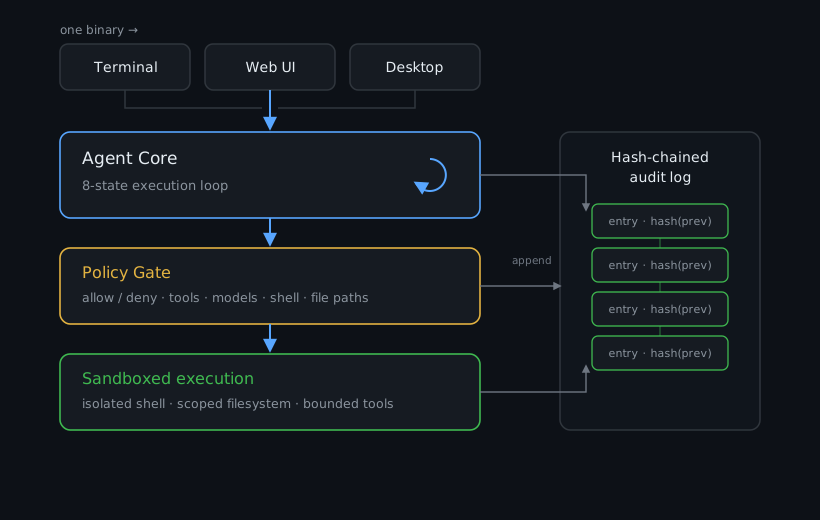
One binary serves three frontends. Every action the agent takes flows through a policy gate, executes in a sandbox, and is appended to a tamper-evident log.
Three ideas do the work: a bounded execution loop, a policy gate in front of every side-effect, and an audit log you can’t quietly edit.
A loop, not a free-for-all
The agent runs a fixed execution loop rather than an open-ended “keep calling tools until done”. Making the control flow explicit is what lets you insert a policy check before any action with side effects, and an audit append after every one.
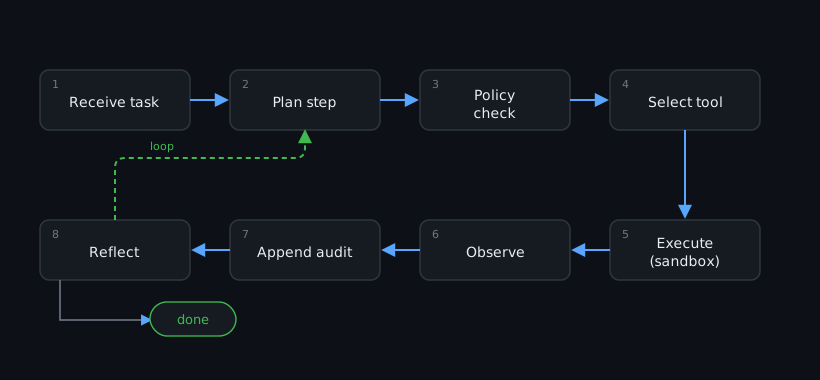
The execution loop, conceptually. The point isn’t the exact stages — it’s that policy and audit sit on fixed edges of the cycle, so nothing side-effecting slips past them.
Because the loop is a state machine, the deterministic parts stay deterministic: routing, retries, and gating don’t depend on the model behaving.
Policy over tools, models, shell, and file paths
The policy gate is the heart of it. Before the agent runs a tool, calls a model, executes a shell command, or touches a file, the request is checked against an org policy:
- Tools — only an allow-listed set is callable.
- Models — which providers/models are permitted (keeping code off unapproved endpoints).
- Shell — commands are constrained, not handed a blank prompt.
- File paths — reads and writes are scoped; the agent can’t wander outside its lane.
Denied actions never reach the sandbox. In a regulated shop this is the difference between “an AI touched our code” and “an AI operated inside a documented, enforced boundary.”
An audit log an auditor trusts
Every action is appended to a hash-chained log: each entry stores the hash of the previous one, so the entries form a chain.
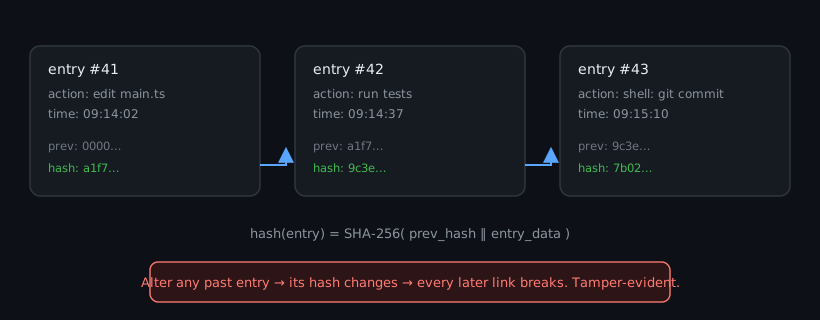
Each entry hashes the previous entry’s hash together with its own data. Change one line of history and every downstream hash stops matching — so tampering is detectable, not silent.
This is the same tamper-evidence idea a blockchain uses, minus the distributed consensus you don’t need for a local audit trail. You don’t get “nobody can ever change it”; you get something better for compliance: if anyone does, it shows.
Why one binary, three frontends
The same core ships as a terminal app, a web UI, and a desktop app. Beyond convenience, it means the policy and audit guarantees are identical no matter how a developer drives the agent — there’s no “relaxed” mode hiding behind a different entry point.
Takeaways
- Constrain the loop before you enrich it. A fixed cycle is what gives policy and audit a place to live.
- Put enforcement in front of side-effects, not in the prompt. Prompts advise; gates enforce.
- Make history tamper-evident, not just stored. For anything auditable, detectability beats good intentions.
DvalinCode is MIT-licensed and on GitHub. The diagrams here are explanatory, not screenshots. Next up: notes on the policy language itself.